
Author Lauren Small on Storytelling, Setting, and Social Justice in ‘Radegonde and the First Crusade’
March 2, 2026
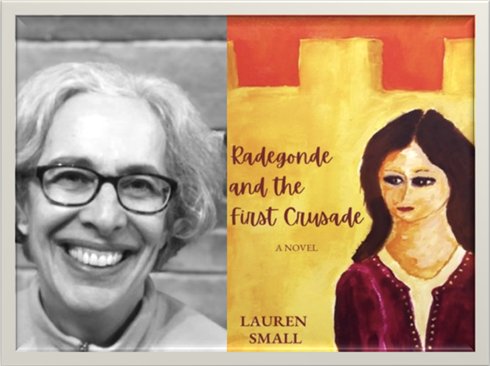
“I always had my nose in a book. For a long time, I was sort of consuming stories. It wasn’t until later that I started to think maybe I could write them, too.”
In this month’s issue of Writer Chat, Brickhouse Books sat down with author Lauren Small to talk about her new release, Radegonde and the First Crusade, as well as when she knew she was meant to be a storyteller, the importance of setting in historical fiction, how character fuels her fiction, and how her passion for social justice led to setting her new story nearly 1,000 years in the past.
Brickhouse Books: In addition to holding a Ph.D. in Comparative Literature, you’ve been a teacher, essayist, novelist, and volunteer in the pediatric oncology outpatient clinic at Johns Hopkins Hospital. That’s a lot of hats to wear. But it seems the common thread is curiosity. Would you agree?
Lauren Small: Yeah, you know, I've never thought about it that way, but yeah, I definitely am driven a lot by curiosity, and about the desire to explore new things.
Brickhouse Books: I read a piece that you published a few years back that, when your parents divorced, you found a way to comfort your brother through it by telling him stories. Was that your lightbulb moment of, Oh, this is what I’m meant to do?
Lauren Small: You know, it's funny that you bring that up. I was a very small child. I was literally, like, 4, 5, 6 years old when I was doing this little storytelling, and it wasn't until much later that I looked back on it and saw a thread there to connect my life. But I think what connected me initially with the whole idea of literature and writing was reading. In the old days, they used to call us bookworms. I always had my nose in a book. For a long time, I was sort of consuming stories. It wasn't until later that I started to think maybe I could write them, too.
Brickhouse Books: Your past books have touched on settings of Nuremberg, 1860s Colorado, and 1900’s Baltimore. Your new book, Radegonde and the First Crusade, takes place in 1096’s Europe. What importance does setting play in your fiction?
Lauren Small: Well, it's very true. Setting does play an important role for me—and place. I don't seem to be able to write about a place unless I've been there. I guess this latest book is a little bit of an exception for that, because there are some places in Radegonde that I wasn't able to get to, and I had to just do a really deep dive into research about the place and looking at photographs and images and maps and things like that to sort of make up for what I was missing. But otherwise, yeah, I definitely need to ground myself. I want to know the history of the place I'm writing about, the weather, how it impacts people, and my stories do come out of that.
Brickhouse Books: What made you set your story a thousand years in the past? Was it the setting of the First Crusade itself, or were you more interested in visiting a time period that you could have never visited in reality?
Lauren Small: I have a really strong passion for social justice, and I see things in the world that drive me crazy. Like, How can that be? And then I sort of want to understand how these things came to happen, so I find that I need to go back in the past to see the roots of it.
As far as the Radegonde book is concerned, I've been very concerned lately with what I see in America as a rise of strains of fascism, militant white Christian nationalism, and anti-Semitism. And when I started trying to understand where all this was coming from, I began to see that it really does have its origins a thousand years ago into the First Crusade, which is when you had, in Europe, your first organized militant white Christian movement, and the sort of structured rise of anti-Jewish violence. Those things are a result of the First Crusade, or they happened during the First Crusade, and those strains are still with us now. It's a thousand years ago, but I feel a very strong connection to what we're living through today.
Brickhouse Books: You’ve mentioned Radegonde is a story of adventure, love, hope, faith, and forgiveness. Are these themes you wanted to hit on from the beginning, or did they come into focus as you were writing?
Lauren Small: I think they really developed through the writing process. I always end up writing about individual characters. That’s what fuels my fiction. I might start with a larger concept or a larger idea, but ultimately, I have to embody that story in individual characters. People. And then I need to understand the people and their journeys, and where they're coming from and where they end up. And there's always an arc there, and that's where you might see some characters are, perhaps, destroyed by the particular journey of the novel, but others are resilient, and they have a different outcome, and they learn something from it, and they can become stronger, more resilient, and more hopeful. So, we really see both of that happening in Radegonde and the First Crusade. I don't know the stories until I write them. I just start somewhere, and then I start going, and I see where it takes me.
Brickhouse Books: What usually ends up inspiring a new work — a character, setting, or theme?
Lauren Small: I think I probably start with theme because I'm looking at these larger events…and then I start looking more into individual places and creating individual characters that can inhabit that story. And at that point then, I'm really open to seeing where the story takes me and how the characters develop as I go along.
Brickhouse Books: You’ve said that writing fiction remains your greatest challenge and your greatest passion. What’s the challenge?
Lauren Small: I've been writing fiction for a long time now. Probably close to 40 years. In the beginning, the difficulty was figuring out what I wanted to put on the page. Somehow you want to put yourself authentically out there, but you also have a certain sense of a private life that you maybe don't want to expose, and there was a lot of tension in my early writing along those lines. But I would say as the years have gone by, I've just become more and more engaged with the world, and so now my challenge is sometimes research. Finding the information that I need, or sorting through the information that I need in order to create a story. Trying to figure out how I can best embody this historical period, or the themes that I'm engaging. How I can be fair and accurate to the extent that I can to the historical time.
Brickhouse Books: So, speaking of some of that research, what does your writing process look like in terms of how many drafts you go through before you start to say, Okay I think I'm getting to where it's matching what's in my head?
Lauren Small: I would say most of my books lately go through probably 4 major drafts. But along the way, I'm just constantly revising and tweaking and reworking. If I'm in the middle of a novel, the first thing I'll do is I'll back up a good 10 or 20 pages and just re-read what I wrote over the last day or two, and then I start tweaking that and changing it, and then that sort of gets me back into the project. And then I start moving forward into new territory. I might get out a couple more pages, and then the next day I repeat again. So it's a back and forth, constantly looking and revising. But I love to revise. I do. I love it. It's like a puzzle, and you're trying to put it together.
Brickhouse Books: Other writers have said that a book is never finished, only abandoned. When do you feel like you hit the point when you can say, Okay, I’ve made this the best I can make it?
Lauren Small: I think what happens is that I need to move on to something new. It just sort of forces me to kind of put the book aside because I want to move on to other things. I have two friends who are writers, and they're always my first readers. And so I'll get the draft through them, and then I'll have another draft after that. I usually have my husband [who] will read next, and then that'll occasion more changes. And then after that, I have a group of about 4 or 5 really good friends who are really avid readers. So it’s a process of getting it to a certain point for myself, and then moving it through these groups of readers, one after another, and continuing to revise until finally it feels like, Okay, I think this will work for a general audience now.
Brickhouse Books: So now that Radegonde is out, what are you working on for the future? Is there a specific time period that's calling to you?
Lauren Small: Well, I seem to still be a little interested in the Middle Ages. I just finished the second draft of a novel about Maimonides, who was probably the most significant Jewish thinker of all time. He lived in Egypt around the time of the Crusades, so there's a connection there. I was fascinated by his life because he lived for 20 years of his life as a Muslim. He was born Jewish, and he maintained his Jewish religion, but at a certain point, there are some questions that he may even have converted to Islam. He became a great theologian, Jewish scholar, legal theorist, and all of that experience he had with Islam got incorporated into his writings, and he sort of revolutionized Jewish thinking on this merging of Islamic and Jewish cultures. I'm very interested in that symbiosis of an interaction. I feel like it's relevant today.
[This interview has been edited and condensed for content and clarity]